Here’s something most homeowners don’t think about until it becomes a real problem: the garage floor is one of the most abused surfaces in any home. Oil drips, tire marks, road salt, chemical spills, grease, rust stains, and years of accumulated grime: your garage floor takes punishment that no other surface in your home comes close to matching. And yet it’s one of the most consistently neglected cleaning tasks in most households. Sound familiar? You’re definitely not alone!
The thing is, a dirty garage floor isn’t just an eyesore. Grease and oil buildup create genuine slip hazards. Chemical residue can damage concrete over time, leading to expensive repairs. And a neglected garage floor affects the entire feel of the space, making it feel less like a functional part of your home and more like a storage dumping ground. With the right approach, cleaning and maintaining a garage floor is far more achievable than most people think.
Understanding Your Garage Floor Before You Clean It
Before reaching for a brush or a bottle of degreaser, understanding what type of garage floor you have and what specific challenges it presents is the foundation of effective cleaning. Different floor types respond very differently to the same cleaning approaches, and using the wrong method on the wrong surface can cause damage that costs significantly more to fix than the original stain.
The Four Main Garage Floor Types
Bare concrete is the most common garage floor type and the most challenging to clean. Concrete is naturally porous. Its open surface structure absorbs liquids readily, allowing oil, grease, and chemicals to penetrate deeply into the material rather than simply resting on the surface. The depth of penetration determines how difficult a stain is to remove. A fresh oil spill absorbed hours ago is far more treatable than one that has been soaking into porous concrete for months or years. Bare concrete can handle the most aggressive cleaning approaches, acid etching, strong degreasers, and pressure washing. Without surface damage.
Sealed concrete has had a penetrating or topical sealer applied that fills the concrete’s pores and creates a protective barrier between the surface and contaminating substances. Sealed concrete is easier to clean than bare concrete because stains can’t penetrate as deeply, and most contamination sits on or near the surface of the sealer rather than in the concrete itself. The cleaning consideration is that harsh chemicals and highly abrasive cleaning methods can damage or strip the sealer, leaving the underlying concrete vulnerable. Cleaning sealed concrete requires products that clean effectively without degrading the sealer chemistry.
Painted concrete has a layer of floor paint, typically an alkyd or latex floor paint, applied over the concrete surface. The paint provides a degree of stain protection while giving the floor a more finished appearance. Painted floors require gentle cleaning approaches that remove surface contamination without lifting or bubbling the paint layer. Acidic cleaners, highly concentrated degreasers, and abrasive mechanical tools can all damage painted surfaces.
Epoxy-coated floors have a two-component epoxy system applied over the concrete, creating a hard, smooth, highly chemical-resistant surface layer. Epoxy coating is the most durable and easiest to clean of the four types. Its smooth, non-porous surface prevents contamination from penetrating, and most substances wipe up cleanly from a properly applied epoxy finish. The cleaning consideration is that epoxy coatings, while durable, can be scratched by harsh abrasives and degraded by some strong chemical cleaners.
Concrete Porosity: The Root of Most Cleaning Challenges
Understanding concrete porosity explains why garage floor cleaning is more complex than cleaning most other surfaces. Concrete is a mixture of cement, aggregate, and water. As it cures, water evaporates and leaves behind a network of microscopic pores and capillaries throughout the material. These pores are what make concrete so absorbent. A single quart of motor oil dropped on unprotected concrete can penetrate several inches into the surface within hours, and the deeper the contamination penetrates, the more aggressive the treatment needed to draw it back out.
Temperature affects the penetration rate significantly. Oil and grease penetrate faster into warm concrete than cold, which is why summer spills left untreated are typically harder to remove than winter ones. This is also why prompt response to fresh spills, absorbing and treating them before they have time to penetrate deeply, is the most effective strategy for preventing the stubborn staining that makes garage floor cleaning so challenging.
The Most Common Garage Floor Stains
Knowing what you’re dealing with before you start determines which products and techniques to apply. Motor oil and engine grease are the most common and most penetrating, dark, spreading stains that range from fresh golden-brown to old black. Transmission fluid and brake fluid leave similar staining patterns with slightly different chemical compositions. Tire marks leave black rubber transfer marks on the floor surface. These are surface-level stains that don’t penetrate deeply but resist standard cleaning. Rust stains come from metal objects left sitting on the concrete, and distinctive orange-red marks from iron oxide transfer. Battery acid creates discolored, pitted areas where the concrete chemistry has been chemically altered. Road salt and calcium chloride ice melt leave white crystalline deposits and can cause surface spalling over time. And paint, coolant, and various workshop chemical spills each require their own specific treatment approach.
Essential Tools and Products for Garage Floor Cleaning
The right equipment makes garage floor cleaning dramatically faster and more effective. Here is everything you need to tackle any garage floor cleaning challenge, from routine maintenance to full restoration.
Brushes: The Foundation of Manual Cleaning
A stiff-bristled deck brush, with natural or synthetic bristles dense enough to provide real scrubbing force, is the essential manual cleaning tool for concrete garage floors. The long handle provides leverage for applying meaningful scrubbing pressure across the floor surface without requiring you to crouch or kneel. A 12 to 18-inch brush width handles open floor areas efficiently, while a narrower detail brush handles corners, edges, and the areas around floor drains where debris concentrates.
For particularly stubborn contamination, a stiff-bristled hand scrub brush allows targeted pressure application to specific stained areas that the deck brush can’t address with sufficient focus. And for cleaning the joints and cracks in concrete where grime concentrates and a flat brush can’t reach, an old stiff-bristled toothbrush or narrow grout brush handles these detail areas effectively.
Pressure Washers: The Most Effective Tool for Large Areas
A pressure washer, whether an electric model for lighter use or a gas-powered unit for serious cleaning, is the single most effective tool for cleaning concrete garage floors over large areas. The combination of high-pressure water and appropriate cleaning solution removes surface contamination, loosens embedded grime, and rinses the floor thoroughly in a fraction of the time that manual scrubbing requires. For garage floors larger than a single bay, a pressure washer isn’t just convenient, it’s practically essential for achieving a genuinely thorough result.
Electric pressure washers in the 1,500 to 2,000 PSI range are appropriate for regular maintenance cleaning and for use on sealed, painted, or epoxy surfaces where gentler pressure protects the coating. Gas-powered washers in the 2,500 to 3,500 PSI range provide the additional force needed for deep cleaning bare concrete and for dislodging heavily embedded contamination. Always use a 25-degree or 40-degree fan tip for general surface cleaning, never a zero-degree pinpoint tip, which concentrates enough force to etch and damage even bare concrete at close range.
Commercial Cleaners and Degreasers
Several commercial products deliver exceptional results on garage floor contamination. Zep Heavy Duty Citrus Degreaser is consistently one of the highest-rated garage floor degreasers, a concentrated formula that dilutes for regular cleaning or is used at full strength for serious contamination. Simple Green All-Purpose Cleaner, diluted to the appropriate strength for the contamination level, handles most garage floor cleaning tasks effectively and is safe on sealed and coated surfaces. Purple Power Industrial Strength Cleaner and Degreaser is a highly effective option for the most serious contamination. Krud Kutter Concrete Cleaner and Degreaser is formulated specifically for concrete surfaces and handles both oil and general grime effectively.
For rust stains specifically, CLR Calcium Lime Rust Remover and Bar Keepers Friend are both highly effective. For efflorescence, the white powdery mineral deposits that appear on some concrete floors, a dilute muriatic acid solution or a commercial efflorescence remover is the appropriate treatment.
DIY Cleaning Solutions
Several effective garage floor cleaners can be made from household ingredients at minimal cost. Dish soap and hot water, particularly Dawn Platinum, which is formulated to cut through grease, is surprisingly effective on fresh oil and general floor grime when applied generously, allowed to dwell, and scrubbed firmly. Baking soda paste, baking soda mixed with just enough water to form a thick spreadable paste, is effective on dried oil stains and provides gentle abrasion without damaging concrete. And for pre-treating fresh oil spills before the main clean, cat litter, standard clay-based litter, rather than clumping formulas, is one of the most effective absorbent materials available for drawing fresh oil from concrete before it penetrates deeply.
Protective Equipment
Garage floor cleaning involves concentrated cleaning chemicals, degreasers, and potentially acid treatments that require appropriate protective gear. Chemical-resistant rubber gloves are essential. Nitrile gloves provide good chemical resistance for most garage cleaning scenarios. Safety glasses or goggles protect against splashing when applying cleaning solutions and pressure washing. Non-slip footwear is critical on wet concrete where a cleaning solution makes the surface dangerously slippery. And for ventilation, ensure the garage door is open during any cleaning involving concentrated chemicals or acid treatments. Adequate airflow prevents the buildup of fumes in the enclosed space.
How to Clean a Garage Floor: The Complete Step-by-Step Process
This is the complete, correct sequence for a thorough garage floor clean, whether you’re doing a routine maintenance clean or a more intensive annual session.
Step 1: Clear the Garage Floor Completely
Before the first cleaning action, clear the entire floor. Move vehicles, equipment, storage items, and anything else on the floor out of the garage or into temporary positions that allow complete floor access. This step feels tedious, but it is essential. Cleaning around obstacles produces an incomplete result, and the areas under and around furniture are where the most significant contamination often accumulates. Use this opportunity to remove items you haven’t used recently. A decluttered garage is easier to maintain and clean long-term.
Step 2: Dry Sweep Thoroughly
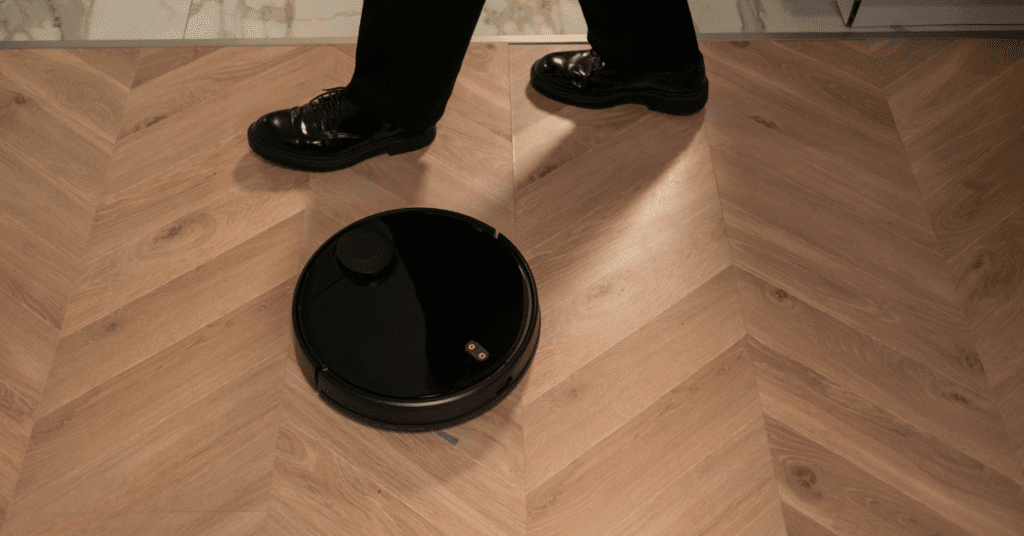
A thorough dry sweep before any wet cleaning removes the loose debris, dust, dirt, sand, and grit that would otherwise be pushed around or ground into the floor surface by wet cleaning. Use a stiff deck brush to work debris from corners and along edges toward the center of the floor, then collect with a wide dustpan or push it to the door and sweep out. Pay particular attention to the corners, along the walls, and around the floor drain where debris concentrates most heavily. Alternatively, a shop vacuum handles this stage quickly and thoroughly, capturing fine dust that a sweep redistributes into the air. And if you don’t feel like vacuuming yourself, consider a robot vacuum that does the work for you:

Step 3: Pre-Treat Stains Before the Main Clean
Identify all stained areas and apply targeted pre-treatment before applying the general cleaning solution across the full floor. For oil and grease stains, apply degreaser directly and concentrated, allow it to dwell for 5 to 10 minutes before scrubbing. For rust stains, apply your rust remover product at this stage. For tire marks, apply a dedicated rubber scuff remover or concentrated degreaser. Pre-treating stains before the general floor cleaning ensures that the targeted treatment has maximum contact time with the contamination rather than being diluted by the general cleaning solution applied across the whole floor.
Step 4: Apply the Main Cleaning Solution
Mix your chosen cleaning solution at the appropriate dilution for your floor type and contamination level, and apply it generously across the entire floor surface. For general maintenance cleaning, a dilute degreaser solution applied with a garden watering can, a mop, or a pressure washer’s detergent applicator covers the floor evenly. Allow the solution to dwell on the surface. This is critical and widely skipped. A 5 to 10 minute dwell time allows the cleaning chemistry to penetrate the concrete surface, emulsify oils, and loosen embedded grime before any mechanical scrubbing begins. The dwell time does more cleaning work than the subsequent scrubbing in many situations.
Step 5: Scrubbing Technique
With the cleaning solution active on the floor, scrub systematically across the entire surface with your stiff deck brush. Work in sections, applying firm downward pressure and using back-and-forth strokes that maintain consistent coverage. For bare concrete with significant contamination, circular scrubbing motions work into the pores more effectively than linear strokes for particularly dirty areas. Keep the cleaning solution wet on the floor throughout the scrubbing phase. If it begins to dry, apply additional solution. For large garage floors, a floor scrubbing machine or rotary floor polisher with a scrubbing pad attachment dramatically reduces the physical effort and produces more consistent results than manual scrubbing.
Step 6: Rinse Thoroughly
A thorough rinse is as important as the scrubbing phase. Cleaning solution left to dry on the garage floor leaves a residue that attracts more dirt and, in some formulations, degrades sealed or coated surfaces over time. Use a garden hose with a spray nozzle set to a strong stream, or your pressure washer at the appropriate setting, to rinse the entire floor systematically. Work the rinse water toward the floor drain or out the garage door. Never allow dirty rinse water to pool on the floor and redeposit contamination. For floors without a central drain, squeegee the rinse water toward the door and out of the garage after each rinse pass.
Step 7: Dry the Floor Completely
Allow the cleaned floor to dry completely before returning any vehicles, equipment, or stored items. Depending on your climate, temperature, and the amount of water used during cleaning, drying time ranges from a few hours to a full day. Accelerate drying by opening all garage doors and windows to maximize airflow, running a fan directed across the floor surface, or using a squeegee and dry mop to remove standing water before air drying. Never apply any sealer, coating, or paint to a garage floor that isn’t completely dry. Moisture trapped under a coating causes adhesion failure and bubbling.
How to Remove Oil and Grease Stains from Garage Floors
Oil and grease stains are the most common and most challenging garage floor cleaning task. The approach varies significantly based on how fresh the stain is and how deeply it has penetrated the concrete.
The Cat Litter Method for Fresh Spills
For oil or grease spilled within the last few hours, before it has had time to penetrate deeply, the immediate priority is absorption rather than cleaning. Cover the entire spill generously with standard clay-based cat litter, pressing it lightly into the spill to maximize contact. Leave it in place for a minimum of 30 minutes, several hours is better for larger spills. The cat litter absorbs the bulk of the oil from the concrete surface and upper pores, dramatically reducing the amount of contamination that a subsequent cleaning treatment needs to address. Sweep up the saturated litter, dispose of it as hazardous waste, and then treat the remaining stain with degreaser. The difference in stain severity between promptly absorbed and untreated fresh spills is dramatic and consistently significant.
Dish Soap and Hot Water for Light to Moderate Staining
For oil stains that are a few days to a few weeks old and haven’t yet penetrated to a significant depth, the dish soap and hot water method is surprisingly effective. Apply a generous amount of concentrated dish soap. Dawn Platinum is the most effective, commonly available option. Apply it directly onto the stain. Use the hottest water you can produce from your tap to work the soap into the stain with a stiff brush. The hot water reduces the viscosity of the oil, making it easier to emulsify and lift. Allow the soapy solution to dwell for 10 to 15 minutes, scrub firmly with circular motions, and rinse thoroughly. Repeat up to three times for stubborn staining. The cumulative effect of multiple applications is often more effective than a single aggressive treatment.
Commercial Degreaser for Significant Staining
For established oil stains and general grease contamination across the garage floor, a commercial degreaser is the most effective treatment. Apply the degreaser at full strength or at its highest recommended dilution for heavy contamination, cover the entire stained area generously, and allow to dwell for the full manufacturer’s recommended time. This dwell time is where the degreaser chemistry works. The surfactants penetrate the concrete pores and begin breaking the bond between the oil molecules and the concrete. After the dwell time, scrub firmly with a stiff brush and rinse thoroughly. Multiple applications are usually more effective than a single extended treatment for deep staining.
Baking Soda Paste for Dried, Set-In Stains
For oil stains that have dried and set into the concrete surface, a thick paste of baking soda and a small amount of dish soap applied directly to the stain and left to dwell for several hours before scrubbing is an effective treatment option. The mildly alkaline chemistry of baking soda helps break down the acidic oil compounds, and the paste consistency maintains contact with the stain surface throughout the dwell time rather than running away from the treated area. For large dried stains, cover the applied paste with plastic sheeting to prevent it from drying out prematurely during the dwell period.
Poultice Treatment for Deep, Penetrating Stains
For old oil stains that have penetrated deeply into porous concrete, stains that resist the above treatments because the contamination is too deep in the concrete to be reached by surface cleaning, a poultice treatment is the most effective approach. A poultice works by drawing contamination back up through the concrete pores through capillary action. Mix an absorbent material, diatomaceous earth, powdered limestone, or cat litter ground to a fine powder, with a solvent such as acetone, lacquer thinner, or a commercial concrete degreaser to form a thick paste. Apply the paste to the stained area at a thickness of approximately half an inch. Cover with plastic sheeting and seal the edges with tape. Leave for 24 to 48 hours, as the solvent evaporates, it draws the oil upward through the concrete pores and into the absorbent material. Remove the dried poultice and dispose of it as hazardous waste. Repeat up to three times for deep staining.
When Oil Stains Are Too Deep to Clean
Some oil stains, particularly those that have been soaking into unprotected concrete for years, have penetrated to a depth that no surface cleaning treatment can fully address. In these situations, the practical options are floor coatings that cover the stained area, concrete grinding that removes the stained surface layer, or simply accepting the residual staining as part of the floor’s character. An epoxy floor coating applied over a thoroughly cleaned and prepared concrete floor is the most practical solution for garages with extensive deep oil staining that cleaning alone cannot fully resolve.
How to Remove Other Common Garage Floor Stains
Tire Marks and Rubber Scuffs
Tire marks are among the most stubborn surface stains on garage floors. The heat generated during vehicle turning deposits rubber particles onto the concrete surface, where they bond firmly. Standard cleaners often have minimal effect on rubber transfer staining. The most effective approach uses a dedicated rubber scuff remover or a concentrated degreaser applied and left to dwell for 15 to 20 minutes before aggressive scrubbing. For particularly stubborn tire marks, a spray lubricant can be applied and left briefly before scrubbing with a stiff brush to soften the rubber deposit for easier removal. Pressure washing at higher pressure settings after chemical treatment removes the loosened rubber effectively.
Rust Stains
Rust stains from metal objects left on concrete, tool boxes, vehicle parts, metal furniture legs, wheel rims, are distinctive orange-red marks that require acid-based treatment to dissolve the iron oxide compounds. Bar Keepers Friend, made into a paste and applied to the rust stain, is one of the most effective readily available treatments. Its oxalic acid content dissolves iron oxide effectively. CLR applied directly to the stain and left for 5 to 10 minutes before scrubbing and rinsing is another highly effective option. For severe rust staining, a dilute muriatic acid solution, carefully applied with full protective gear in a well-ventilated space, removes deep rust staining that milder acid treatments can’t fully address. Always neutralize acid treatments with a baking soda and water solution and rinse thoroughly after acid treatment of any kind.
Paint Spills
Fresh paint on concrete should be cleaned up immediately. Water-based paint wipes up easily with water and a cloth while still wet. Dried water-based paint responds to warm water and scrubbing for light deposits, or to a paint stripper product for more substantial dried paint areas. Oil-based or enamel paint on concrete typically requires a paint stripper or solvent, acetone, mineral spirits, or a commercial paint remover, applied carefully and allowed to soften the paint before mechanical removal with a plastic scraper. Never use metal scrapers on sealed, painted, or coated floors. The mechanical abrasion causes surface damage beyond the paint area being treated.
Battery Acid Stains
Battery acid, sulfuric acid from lead-acid vehicle batteries, causes a distinctive chemically altered area on concrete where the acid has reacted with the calcium compounds in the concrete, typically producing a lighter colored, slightly rough or pitted area. Before cleaning, neutralize any residual acid with a baking soda and water solution, apply generously, allow the fizzing reaction to complete, and rinse away. The neutralized stain can then be cleaned with your regular concrete cleaner. Note that the physical alteration of the concrete surface caused by acid contact cannot be reversed by cleaning. It’s a permanent change to the surface texture that can only be addressed by coating or resurfacing.
Road Salt and Mineral Deposits
The white, crystalline deposits left by road salt and calcium chloride ice melt dragged in on vehicles are both cosmetically unpleasant and progressively damaging to concrete over time. The freeze-thaw cycling of salt-saturated concrete accelerates surface spalling and degradation. For surface deposits, a stiff brush and hot water, followed by a vinegar solution, the mild acidity dissolves mineral deposits effectively, and removes most road salt contamination. For heavier mineral buildup, a commercial calcium and limescale remover applied and allowed to dwell dissolves the mineral deposits more completely. Prevention is particularly valuable for road salt, a floor mat at the entrance point captures much of the salt before it spreads across the floor.
Mold and Mildew
Mold and mildew on garage floors are typically the result of persistent moisture from leaks, condensation, or water intrusion. A dilute bleach solution, one cup of bleach per gallon of water, applied to affected areas, left to dwell for 10 to 15 minutes, and then scrubbed and rinsed, kills most common mold and mildew species on concrete surfaces. For extensive mold coverage, an oxygen bleach product like OxiClean dissolved in water provides effective treatment without the fume concerns of chlorine bleach in an enclosed space. After mold removal, identifying and addressing the moisture source is essential. Without this step, mold will return regardless of how thoroughly it is cleaned.
Pressure Washing a Garage Floor: The Complete Guide
When Pressure Washing Is Appropriate
Pressure washing is the most efficient method for cleaning large garage floor areas and for the annual or bi-annual deep clean that removes accumulated grime that routine maintenance cleaning leaves behind. It’s particularly effective on bare and sealed concrete where the high-pressure water can penetrate the concrete surface and dislodge deeply embedded contamination. For epoxy and painted floors, pressure washing is appropriate at lower pressure settings, typically under 1,500 PSI, using wider fan tips that distribute the water force over a larger area. High pressure on thin coating layers risks lifting edges, creating bubbles, or causing coating adhesion failure.
The Right Settings for Different Floor Types
For bare concrete receiving a general maintenance clean, 1,500 to 2,000 PSI with a 25-degree fan tip at a working distance of 6 to 8 inches produces excellent results without surface damage. For deep cleaning bare concrete with significant contamination, 2,500 to 3,000 PSI with a 25-degree tip at 4 to 6 inches working distance provides a more penetrating cleaning force. For sealed concrete, stay below 2,000 PSI with a 40-degree tip to protect the sealer surface. For painted concrete and epoxy, keep pressure below 1,500 PSI with a 40-degree tip and maintain a minimum 8-inch working distance.
Pressure Washing Technique
Work systematically from the back of the garage toward the door. This ensures that contaminated water flows in the direction of the exit rather than back over already cleaned sections. Hold the wand at a consistent angle, typically around 45 degrees to the floor surface rather than perpendicular, which directs the water flow in a consistent direction and is more effective at dislodging contamination than a straight-down perpendicular approach. Use overlapping passes with each wand stroke to ensure complete coverage, and maintain a consistent working distance throughout each pass for even cleaning results.
Managing Water Drainage
The most common challenge with pressure washing inside a garage is managing the significant volume of water that the process generates. Garages with a central floor drain have the simplest drainage situation. Water is directed toward the drain throughout the cleaning process. Garages without a drain require a squeegee management approach. Periodically, stop and use a large floor squeegee to push accumulated water toward the garage door and out of the space before it spreads contamination back across the cleaned area. In either case, the rinse water from pressure washing should be considered contaminated with whatever was cleaned from the floor and should not be directed toward landscaping, storm drains, or water sources.
Deep Cleaning a Garage Floor for a Full Restoration
Assessing Your Floor’s Condition
Before beginning a deep clean restoration project, spend 15 minutes walking the entire floor and documenting what you’re dealing with. Note the distribution and apparent depth of oil stains, fresh vs. old, surface vs. penetrating. Identify any cracks, spalling, or surface damage that will need addressing after cleaning. Check for efflorescence, the white powdery mineral deposits that indicate moisture moving through the concrete from below. And assess whether any existing sealer or coating is present and what condition it’s in, peeling, bubbling, or significantly worn coating needs to be stripped before cleaning and recoating.
Stripping Old Coatings
Applying a new sealer or coating over an old, failing coating produces a result that peels prematurely and looks worse than the bare concrete beneath it. If your garage floor has an existing coating that is peeling, bubbling, or significantly deteriorated, stripping it before deep cleaning is the necessary first step. Chemical floor strippers, applied generously, covered with plastic sheeting, and left to dwell for the manufacturer’s recommended time, soften most garage floor coatings for mechanical removal with a floor scraper. For large areas, a floor grinder or angle grinder with appropriate attachments removes stubborn coating residue efficiently.
Acid Etching When Necessary
Acid etching, applying a dilute muriatic acid or phosphoric acid solution to the concrete surface, opens the concrete pores, removes surface laitance, and creates a slightly roughened surface profile that improves adhesion for subsequent sealer or coating application. It’s a mandatory preparation step before applying epoxy coatings and recommended before applying most penetrating sealers. Mix muriatic acid at the manufacturer’s recommended dilution, typically one part acid to ten parts water, always adding acid to water rather than the reverse to prevent dangerous splashing reactions. Apply evenly across the entire floor with a plastic watering can, allow to dwell until the fizzing reaction subsides, and rinse thoroughly with copious clean water. Neutralize with a baking soda and water solution, rinse again, and allow to dry completely before proceeding.
Dealing With Efflorescence
Efflorescence, the white powdery or crystalline deposits that appear on concrete surfaces as water moves through the concrete and carries dissolved minerals to the surface, indicates active moisture movement through the slab. Cleaning efflorescence without addressing its moisture source is a temporary fix. The deposits will return. For the cleaning itself, a stiff brush removes loose surface efflorescence, and a dilute muriatic acid or commercial efflorescence remover dissolves the mineral deposits that mechanical brushing can’t fully dislodge. Address the moisture source, typically poor exterior drainage, inadequate vapor barrier beneath the slab, or condensation, before applying any coating over the treated area.
Sealing and Protecting Your Garage Floor After Cleaning
Why Sealing Transforms Long-Term Maintenance
A properly sealed garage floor is dramatically easier to maintain and clean than bare concrete. Stains can’t penetrate the sealed surface, contamination sits on top of the sealer rather than soaking into the pores, and cleaning becomes a matter of surface wiping rather than deep treatment. The investment of time and cost in sealing immediately after a deep clean is repaid many times over in reduced cleaning effort and time over the years that follow. This is the single most impactful maintenance investment available for any garage floor, more impactful than any cleaning product or technique.
Penetrating Sealers vs. Topical Sealers vs. Epoxy
Penetrating sealers, silane, siloxane, or siliconate-based products, soak into the concrete pores and chemically bond with the concrete material, reducing porosity without changing the surface appearance. They’re invisible once applied, require no special surface preparation beyond clean and dry concrete, and last 5 to 10 years before reapplication. They reduce but don’t eliminate the penetrating staining challenge. Oil will still stain penetrating-sealed concrete, just more slowly and less deeply.
Topical sealers, acrylic, polyurethane, or epoxy-modified formulas, are applied as a coating on top of the concrete surface, creating a protective layer that prevents any surface contamination from reaching the concrete below. They change the floor’s appearance, typically adding a sheen from satin to high gloss, and require more surface preparation than penetrating sealers. They last 2 to 5 years, depending on traffic, before recoating is needed.
Epoxy floor coatings are the premium solution, a two-component system that creates a hard, smooth, highly chemical-resistant surface layer that is genuinely transformative for a garage floor. Epoxy coatings prevent all penetrating staining, are easy to clean, dramatically improve the garage’s appearance, and last 5 to 10 years with proper application and maintenance. The preparation requirements are the most demanding, the concrete must be thoroughly clean, completely dry, properly etched, and free of any moisture vapor transmission issues for the epoxy to bond correctly and last its full lifespan.
Applying a Concrete Sealer
Apply any sealer only to a floor that is completely clean, completely dry, and at the appropriate temperature for the product. Most sealers require application at 50°F or above. Apply penetrating sealers with a garden sprayer or roller in overlapping passes, working toward the garage door. Apply topical sealers with a roller in thin, even coats. Two thin coats produce better results than one thick coat. Follow the manufacturer’s drying time requirements between coats and before returning vehicles or equipment to the floor. Most sealers require 24 to 72 hours before vehicle traffic. Rushing this causes tracking marks and surface damage.
Garage Floor Cleaning for Specific Situations
After Flood or Water Damage
A garage floor affected by flooding requires immediate action to prevent mold development and assess structural damage. Remove all standing water with a wet vacuum or submersible pump as quickly as possible. Open all doors and windows and run fans to maximize drying. A dehumidifier running continuously in the garage significantly accelerates drying in enclosed spaces. Once dry, clean with a mold-inhibiting cleaner, bleach solution, or a commercial mold-preventing concrete cleaner applied across the entire floor area. Inspect for any sealant damage, efflorescence, or concrete surface damage caused by the water event before considering resealing.
Winter Maintenance: Salt, Ice Melt, and Mud
Winter is the most demanding season for garage floors in northern climates. Road salt and calcium chloride dragged in on vehicles and footwear is both difficult to clean and progressively damaging to concrete over time. A heavy-duty floor mat at the garage entrance captures much of the salt and mud before it spreads across the floor. Weekly sweeping during winter prevents salt accumulation from reaching damaging concentrations. A monthly hot water rinse, focusing on the vehicle parking area, dissolves and removes salt deposits before they have time to cause surface spalling. A well-sealed floor handles winter contamination dramatically better than bare concrete.
Garage Floor Before Selling Your Home
A clean, well-maintained garage floor can make a meaningful positive impression on potential buyers, and a stained, neglected one can have the opposite effect. For pre-sale cleaning, prioritize oil stain treatment with repeated degreaser application, rubber scuff removal, and a thorough pressure wash of the entire floor. If the floor’s condition after cleaning suggests that a fresh sealer or coating application would improve the overall impression, the relatively modest cost of a concrete sealer applied over a clean floor produces a visibly refreshed result that photographs well and shows well during viewings.
How to Keep Your Garage Floor Clean Long-Term
Daily and Weekly Maintenance Habits
The most effective long-term garage floor maintenance strategy is preventing significant contamination accumulation rather than periodically addressing severe buildup. A weekly dry sweep of the entire floor takes five minutes and removes the tracked-in debris, sand, and grit that causes progressive surface abrasion. Wiping up oil drips and chemical spills immediately, within hours rather than days, prevents the deep penetration that makes these stains so difficult to treat. And a monthly quick mop with dilute degreaser in the vehicle parking area prevents the cumulative grease buildup that develops from routine drips and vehicle condensation.
Garage Floor Mats and Protective Coverings
Interlocking floor tiles, rubber, vinyl, or polypropylene, in the vehicle parking area, provide a durable protective layer that captures oil drips and road contamination before they reach the concrete below. They’re removable for cleaning, can be pressure-washed separately, and dramatically reduce the cleaning requirements of the concrete beneath. For workshops and work areas, rubber anti-fatigue mats protect both the floor and the person standing on it during extended work sessions. A drip tray or absorbent pad placed under vehicles known to drip oil is the most targeted and cost-effective oil stain prevention available, intercepting the drip before it reaches the floor entirely.
Building a Seasonal Cleaning Schedule
A realistic seasonal cleaning schedule prevents the progressive accumulation that makes garage floor cleaning feel overwhelming. Spring: a thorough pressure wash to remove winter salt and grime accumulation, this is the year’s most important cleaning session. Summer: a mid-year degreaser treatment of the vehicle parking area and any stained spots that have developed. Fall: a sweep and rinse in preparation for the winter season, and a sealer inspection to determine whether resealing is needed before salt season begins. Winter: weekly sweeping and monthly rinse to manage salt accumulation.
Conclusion
A clean garage floor transforms the entire feel of the space, from a neglected surface you avoid looking at to a functional, well-maintained part of your home that you’re genuinely proud of. And with the right approach, keeping it that way is far less work than most people expect. The key is understanding your floor type, matching the right products and techniques to your specific stains, and building a simple maintenance routine that prevents the kind of buildup that makes garage floor cleaning feel like a major project every time.
Start with the most impactful action for your specific situation today. If oil stains have been bothering you for months, try the cat litter absorption method on any fresh ones and a commercial degreaser treatment on the established ones. If the floor just needs a general refresh, a pressure wash with detergent will produce results that genuinely surprise you. And if your floor is bare concrete that you’ve been cleaning for years, sealing it after the next thorough clean will be the single most impactful investment you make in your garage’s ongoing maintenance.
Your garage floor takes more punishment than almost any other surface in your home. With the right tools, the right products, and the approach outlined in this complete guide, you have everything you need to give it the care it deserves and to keep it looking clean with far less effort than you’ve been putting in. Start today, and enjoy the results for years to come!